In accordance with the product standards for windows EN 14351-1 [1] (and facades EN 13830 [2]), one of the methods for determining the U-valueWSCW There is a calculation method according to EN ISO 10077-1 [3] (EN ISO 12631 [4]).
For the calculation of the heat transfer coefficient, the values of the individual heat transfer coefficients of components such as frames and panes, as well as the linear heat transfer coefficient Ψ (psi), are required.
The parameter Ψ defines heat loss caused by the fitting of the glass pane in the window frame. The value of Ψ largely depends on the type of spacer bar used in the insulating glass unit.
For the calculation of the U-value of windows, the EN ISO 10077-1 and EN ISO 12631 standards specify Ψ values which can be used for both „conventional” and thermally improved spacer bars, and which can be used without further verification.
It is also possible to calculate the Ψ value for thermally improved spacer bars in accordance with EN ISO 10077-2 [5]. In this analysis, it should be taken into account that the Ψ value depends on: the type of profile, the configuration of the insulating glass unit, the appropriate conditions for installing the glass in the window frame, and the material of the window frame.
Sample values of Ψ
To check the performance properties of products in accordance with product standards, „representative test samples” must be used. For example, it is sufficient to calculate the U-value.W) for reference sizes only, as specified in standard EN 14351-1.
Similarly, other properties, such as air permeability or sound insulation, can be determined using representative samples for testing. In the same way, Ψ values for thermally improved spacers can be established based on representative samples of profiles and insulating glass units.
This approach offers two main advantages:
- The values of Ψ determined in this way can be used in the manufacturer's declaration regarding the thermal transmittance coefficient.
- Based on uniform boundary conditions, it is possible to reliably and objectively compare the results of thermally improved spacer bars when determining the value of Ψ.
(…)
Psi values for windows
The IFT Institute Guidelines no. WA-03/08 [6] concerning windows specify a method for calculating representative Ψ values for thermally improved spacer bars, in combination with window frame profiles.
The values of Ψ are specified for the frame profiles from the following materials:
- wooden,
- wood-aluminium,
- of PVC,
- Metal.
Window profiles allow the installation of both single-chamber and double-chamber insulating glass units. The IFT guidelines specify example profiles and representative insulating glass unit configurations as follows:
- 4/16/4 double glazing unit and Ug = 1.1 W/(m²K)2K
- double-glazed unit 4/12/4/12/4 and Ug=0.7 W/(m²K)2K
When using representative Ψ values to calculate the U-value, the following principles apply:
The calculated representative values of Ψ can be used for the following insulating glass units:
- single-chamber double glazing Ug≥1.0 W/(m2K), filled with argon or air;
- double-glazed insulating glass Ug≥0.5 W/(m2filled with argon or air.
2. Representative Ψ values were calculated for glass panes of 4 mm thickness each. If thicker glass panes are used, the Ψ values must be increased, as follows:
- 0.001 W/m2K) for a 1 mm thick growth of the outer glass pane
- 0.002 W/(m2K) 1 mm thick internal glass pane growth
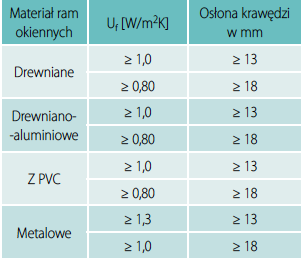
3. Before applying representative Ψ values, check that the UF values and the height of the glazing beads of the actual window profiles correspond to those listed in the table below.
Table 1. Requirements for the Uf value of window profiles permitting the use of generally calculated representative Ψ values
The Technical Committee for Warm Edge from the German Flat Glass Association (BF) publishes the Ψ (psi) value coefficients on data sheets, which can be downloaded free of charge from the association's website (www.bundesverband-flachglas.de).
In addition to the example values of Ψ, the technical data sheet also provides the „equivalent thermal conductivity” of the spacer frame, which will be discussed in detail later in this article.
Values of the Ψ coefficient for facades
Example values of Ψ, determined on the basis of IFT Requirement no. WA 3/8, may only be used for calculating the thermal transmittance of windows in accordance with EN ISO 10077-1. They cannot be used for calculations concerning curtain walls.
The IFT Rosenheim research project on developing a method for calculating sample Psi-values for thermally improved spacer bars used in curtain wall glazing is currently underway, in order to determine the U-value of the curtain wall (UCW) as easily as for windows.
As part of the project, sample facade profiles and glass configurations will need to be provided. Other parameters and their impact must also be included in the calculations, including values such as: glass pane thickness, U-value of facade profiles, and the height of internal and external seals.
The project is funded and overseen by the Working Committee for Warm Edges of the German Flat Glass Association (BF), and the guidelines are expected to be available by the end of this year.
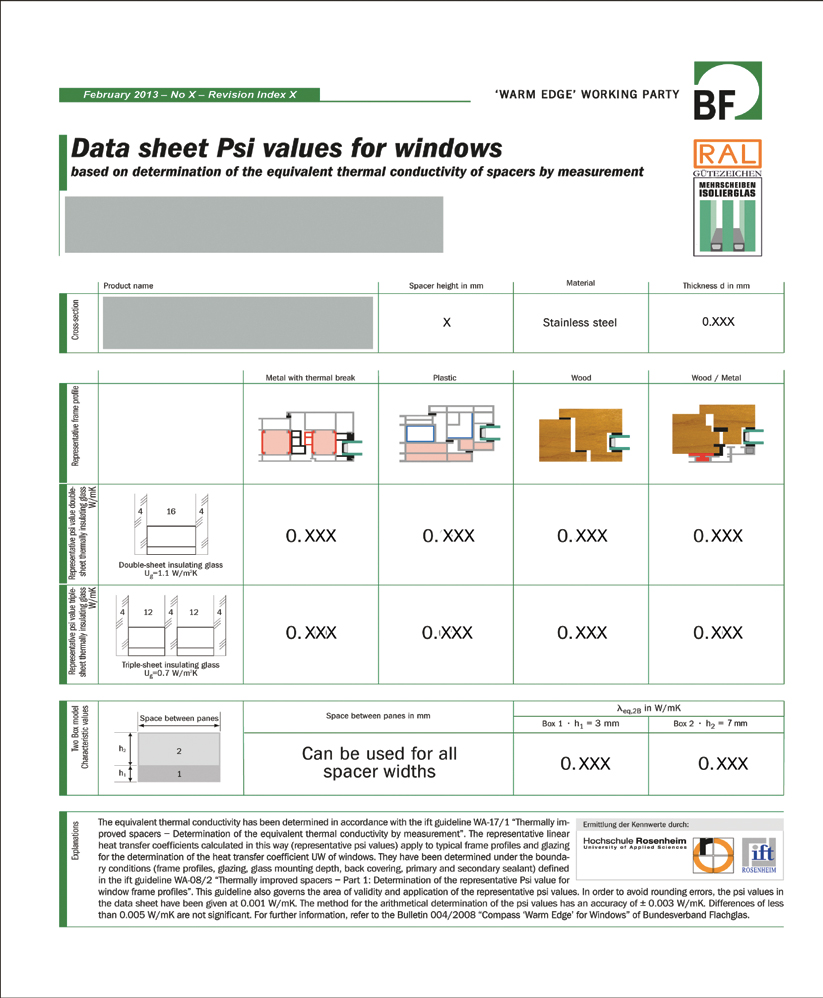
Fig. 1. Technical data sheet published by the German Flat Glass Association
Determining the thermal conductivity of a sample spacer bar
The example Ψ values provided in IFT Guideline WA-08/3 are calculated numerically according to the methodology presented in standard EN ISO 10077-2. This requires precise knowledge of the geometric cross-section of the spacer bar and the thermal conductivity of the individual materials.
In some cases, the thermal conductivity of individual materials can be read from relevant standards, but for new materials, this conductivity must be measured. In the past, all types of measurement techniques used were not precise, so very different results were sometimes obtained. It is therefore important to determine appropriate measurement techniques for all materials that can be used in windows. Research in this area in the past has encountered various difficulties, for example, there was a problem with accounting for anisotropic properties.
Another possible solution would be to define not the thermal conductivity of all individual materials, but the „equivalent” thermal conductivity of the spacer frame system as a whole. This approach eliminates the problems mentioned above, requires a simpler methodology, and also offers other advantages that will be described below.
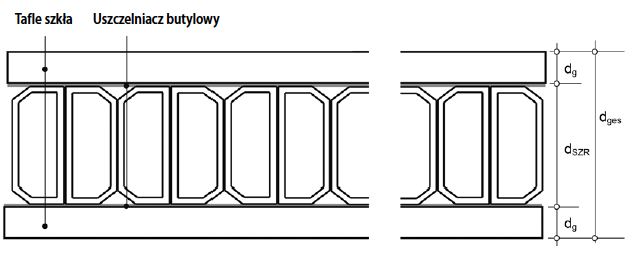
Fig. 2. Basic construction of the investigated samples for determining equivalent thermal conductivity
Research project [7] was carried out to determine the appropriate methodology according to which the equivalent thermal conductivity of thermally improved spacer bars is essentially determined based on the EN 12664 standard. Properties thermal properties of building materials and products. Determination of thermal resistance using the guarded hot plate and heat flux sensor methods. Dry and damp products with medium and low thermal resistance.Thermal resistance is determined using „special” test samples consisting of two panes of glass, between which are thermally improved spacer bars. IFT Guideline no. WA-17/1 [8] describes this method in detail.
The equivalent thermal conductivity (lequal, 2BThis can then be used to calculate the linear thermal transmittance coefficient Ψ of a specific spacer bar in a particular application. This is done using the „two-box model” when the detailed geometry of the spacer bar profile has different thermal conductivity values. Such an element is represented by a rectangle („box”) of appropriate height and is characterised by an equivalent thermal conductivity coefficient corresponding to the actual spacer bar element. Applying the „two-box model” can avoid errors when calculating the Ψ value caused by complicated spacer bar details. Furthermore, much less time is needed to develop the spacer bar system model. This approach significantly simplifies the calculation process for individual cases.
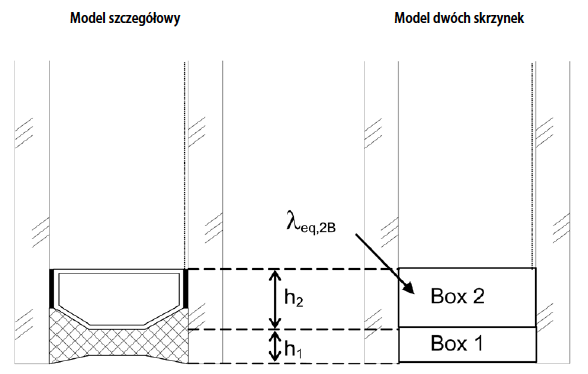
Fig. 3. Two-box model
Conclusions
The methods described above, and as specified in EN ISO 10077-1, provide window manufacturers with simple and practical tools for quickly and easily calculating the impact of the spacer bar when calculating window thermal transmittance. The „rules of the game”, developed in cooperation with the Technical Committee for Warm Spacers of the German Flat Glass Association (BF) and with input from other institutions such as the British Fenestration Rating Council, have provided a uniform basis for the assessment of thermally improved spacer bars.
Mr Norbert Sack
Rosenheim University of Applied Sciences
Bibliography
EN 14351-1+A2:2016-10 Windows and doors. Product standard, performance characteristics. Part 1: External doors and windows.
2. EN 13830:2015 Curtain walls. Product standard.
3. EN ISO 10077-1:2007 Thermal performance of windows, doors and blinds. Calculation of the U-value. Part 1: General provisions.
4. EN ISO 12631:2013-03 Thermal performance characteristics of curtain walls. Calculation of the heat transfer coefficient.
EN ISO 10077-2:2012 Thermal performance of windows, doors and blinds. Calculation of thermal transmittance. Part 2: Computer calculation for frames.
6. WA-08/3:2015 Thermally improved spacers. Part 2: Determination of the equivalent thermal conductivity by means of measurement, iRosenheim Station.
7. N. Sack, F. Feldmeier, W. Albrecht: Determination of the equivalent thermal conductivity of thermally improved spacers – final report ISBN 978-3-86791-339-3, ift Rosenheim 2012.
8. EN 12664:2002 Thermal properties of building materials and products. Determination of thermal resistance by the guarded hot plate and heat flow meter methods. Dry and damp products with medium and low thermal resistance.
9. ift Guideline WA-17/1 Thermally improved spacers. Part 2 Determination of the equivalent thermal conductivity by means of measurement, ift Rosenheim 2013.
The full article in the edition printed i electronic
Other articles on a similar topic, see Themed Services
More information: Glass World 03/2017